Section 7E Abolished: What It Means for Pakistan Property Owners in 2026 | Land Holders
✅ Court Ruling🏠 Property Tax📋 Action Guide
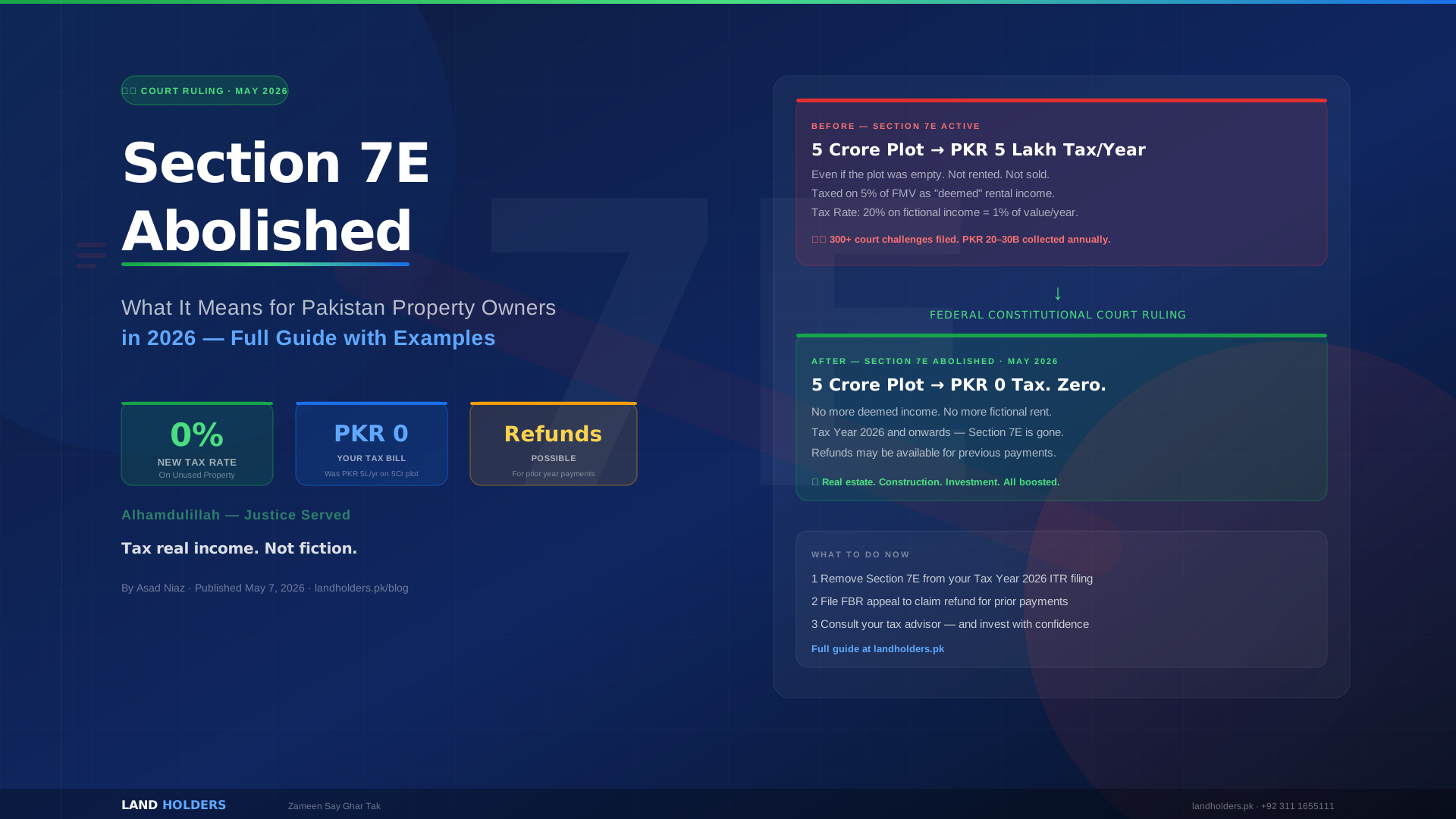
Pakistan's Federal Constitutional Court has struck down Section 7E of the Income Tax Ordinance 2001 as unconstitutional. The era of paying tax on income you never earned — on properties you never rented — is over. Alhamdulillah. Here is everything you need to know.
Asad NiazMay 7, 202615 min read✅ Breaking — May 2026
Federal Constitutional Court declares Section 7E unconstitutional — ultra vires the Constitution of Pakistan
Deemed rental income tax — ended. Property owners across Pakistan no longer taxed on fictional income from properties they never rented out.
0%
New Tax Rate
PKR 0
You Now Pay
May 2026
Ruling Date
TY 2026+
Effective From
What Was Section 7E? Understanding the Before Picture
Section 7E was introduced into the Income Tax Ordinance 2001 through the Finance Act 2022. It was — and there is no politer way to put this — a tax on money you never earned. The government took the Fair Market Value of your property, calculated 5% of that as "deemed" (imaginary) rental income, then taxed that imaginary amount at 20%. The result: a real annual tax bill on income that existed nowhere except on paper.
If you owned a plot in Lahore worth PKR 5 Crore and it was sitting empty — not rented, not sold, not generating a single rupee — you still owed the government PKR 5 Lakh every year. No rent received. Tax still due. This is what Section 7E was.
Key Rules Under Section 7E
Deemed Income
5% of FBR-notified Fair Market Value (FMV) treated as rental income — regardless of whether you earned a single rupee
Tax Rate
20% flat tax on the deemed income — effectively 1% of FMV annually on properties above the threshold
Threshold
Only applied to properties with FMV above PKR 25 Million as of June 30 each year
Exemptions
Agricultural land · Properties already taxed on actual rental income · One self-occupied house within applicable limits
⚠️ The Core InjusticeSection 7E targeted the ownership of property — not income from property. A retired teacher who bought a plot with life savings and never rented it out faced the same annual tax bill as a commercial landlord earning millions. This is precisely what made it constitutionally indefensible.
Real Example — How Much Were You Paying Under Section 7E?
Let's make this concrete. You own a 5 Marla plot in Bahria Town Lahore with a Fair Market Value of PKR 2.5 Crore (PKR 25 million) as per FBR's notified rates. You have never rented it. You are waiting for the right time to build. Under Section 7E, here is what FBR expected from you every single year:
📊 Section 7E Calculation — PKR 2.5 Crore Plot Example
Step
Calculation
Amount
Property Fair Market Value (FBR notified)
As per annual FBR notification for your area
PKR 2,50,00,000
Deemed Rental Income
5% of FMV — entirely fictional income
PKR 12,50,000
Section 7E Tax Due
20% flat tax on deemed income
PKR 2,50,000 / year
Over 10 Years
Cumulative tax on a plot you never rented
PKR 25,00,000
🔴 Actual Rental Income Earned
Zero. The plot was sitting empty.
PKR 0
Result: PKR 2.5 Lakh paid every year on fictional income. A 50 million PKR property paid PKR 5 Lakh annually. This is what Section 7E meant in practice.
This was not an edge case. Hundreds of thousands of Lahore and Karachi property owners — middle-class savers, retirees, overseas Pakistanis who invested their life savings — faced exactly this scenario. The section generated PKR 20–30 Billion annually for FBR while simultaneously triggering over 300 court challenges across the country.
📊 The Scale of the ProblemSection 7E affected an estimated 10 million+ property owners across Pakistan's major cities. Lahore and Karachi bore the heaviest burden given their higher FBR-notified property values. Many owners — particularly the elderly and overseas Pakistanis — were unaware they owed this tax at all, leading to notices, penalties, and legal disputes.
Why Was Section 7E Struck Down? The Constitutional Case
The Federal Constitutional Court's ruling in May 2026 was the culmination of years of legal challenge. The Islamabad High Court had already ruled Section 7E ultra vires in 2025. The Federal Constitutional Court's decision finalised the abolition and settled the constitutional question permanently.
⚖️
Constitutional Violation
The Court held Section 7E violated Article 24 of the Constitution — which guarantees protection of property rights. Taxing imaginary income constitutes an indirect tax on the ownership of property itself, not on earnings.
🚫
"Imaginary Income" Doctrine
Income tax can only be levied on real income. Deeming fictional income into existence solely to create a tax liability is beyond Parliament's legislative competence under the constitutional framework for federal taxation.
🏭
Business and Industry Backlash
FPCCI, real estate associations, and construction industry bodies formally challenged Section 7E, calling it a disguised wealth tax that contradicted the government's stated goal of growing the construction and housing sectors.
📅
Court Timeline
2022: Section 7E introduced 2022–2025: 300+ court cases filed 2025: IHC rules ultra vires May 2026: Federal Constitutional Court confirms abolition
✅ What the Ruling Means in Plain TermsA tax that treats you as having earned rental income — when you earned nothing — cannot stand. The court has affirmed what property owners always knew: Section 7E was not a tax on income. It was a tax on existence. The ruling protects not just current property owners but sets a precedent against similar fictional income constructs in future legislation.
Life After Section 7E — What Changes From Tax Year 2026
Effective Tax Year 2026, Section 7E no longer exists. Here is the practical reality for every affected property owner in Pakistan.
💳
PKR 0
Section 7E Tax
No more annual deemed income tax on your property
📋
Removed
ITR Obligation
No 7E declaration or payment in your tax return
⚡
Instant
Relief
Effective from Tax Year 2026 — no transitional period
📂
Possible
Refunds
Prior payments may be recoverable through FBR appeals
The transition is clean and immediate. For Tax Year 2026 returns and all future years, Section 7E simply does not exist. If your tax advisor or accountant still includes a Section 7E calculation in your ITR preparation — correct them immediately. The obligation is legally extinguished.
Before vs After — Complete Comparison
Here is every key aspect of your tax and investment situation — before the ruling and after.
Aspect
Before (Section 7E Active)
After (Abolished — May 2026)
Tax on Unused Property
1% of FMV annually (properties >PKR 25M)
PKR 0 — zero deemed income tax
PKR 5 Crore Plot
PKR 5,00,000 tax per year
PKR 0 per year
PKR 2.5 Crore Plot
PKR 2,50,000 tax per year
PKR 0 per year
ITR Filing
Mandatory 7E declaration + payment
Section 7E removed — no declaration needed
Refunds Available?
N/A
Yes — prior payments via FBR appeal
Real Estate Investment
Burdened — tax on ownership discouraged holding
Freed — buy, hold, sell without penalty
Overseas Pakistani Impact
Tax liability even while abroad with no rental income
No liability on non-rented properties
Construction Sector
Stifled — holding costs increased
Stimulated — no holding penalty
Compliance Burden
High — complex FBR valuations required
Eliminated for this tax head
Legal Status
Ultra vires but enforceable until court ruling
Permanently struck down
Economic Impact — What Section 7E's End Means for Pakistan
The abolition of Section 7E sends a clear signal to property owners, developers, and investors: the state recognises the difference between real income and fictional income. The economic consequences of this ruling extend well beyond individual tax savings.
🏘
Real Estate Boom
Property that was being sold to avoid Section 7E liability is now worth holding. Expect a significant boost in transaction volume and prices as the market re-prices for the new reality.
🏗
Construction Revival
Developers and plot owners who deferred construction to avoid increasing their tax exposure can now build freely. Cement, steel, and labour sectors all benefit directly.
✈️
NRP Investment Returns
Overseas Pakistanis who were deterred by the prospect of a tax bill on property they hold but cannot manage remotely can now invest with confidence. This is significant for remittance-linked real estate investment.
📉
FBR Revenue Impact
FBR loses an estimated PKR 20–30 Billion annually. However, analysts expect this to be partially offset by increased transaction volumes generating more capital gains tax, stamp duty, and withholding tax receipts.
⚖️
Legal Precedent
The Federal Constitutional Court's ruling makes it significantly harder for any future government to introduce a similar deemed income construct. The constitutional protection of real income over fictional income is now firmly established.
🤝
Investor Confidence
One of the most consistent complaints from foreign and diaspora investors about Pakistan's property market was unpredictable, adversarial taxation. Section 7E was Exhibit A. Its removal improves the investment climate meaningfully.
Why Right Now Is the Best Time to Invest in Property in Lahore
Alhamdulillah for this ruling — but beyond the relief it brings, it also creates a genuine investment opportunity. Let's be direct about what is happening in the market.
Section 7E had a chilling effect on property investment. Smart investors who wanted to buy and hold — which is how you generate real returns in real estate — were deterred by the annual tax liability on unsold, unrented property. That chilling effect is now gone. Expect the market to reprice.
Land Holders — Bahria Town Lahore · Based in Sector E
Looking to Invest in Lahore Real Estate Post–Section 7E?
Land Holders is based inside Bahria Town Sector E, Lavandus Block. We transact daily across Bahria Town, Etihad Town, and Lahore's major housing societies. We can guide you to the right investment for your budget and goals — at zero buyer commission.
Your Complete Action Checklist — What to Do Right Now
The ruling is done. Now it is time to act. Here is the exact checklist every Pakistan property owner should work through in the coming weeks.
🔴 Do This Week
1Remove all Section 7E entries from your upcoming Tax Year 2026 ITR. If your accountant or tax advisor has already included them — instruct them to remove. This is no longer a legal obligation.
2Inform your accountant or tax advisor of the Federal Constitutional Court ruling dated May 2026 if they are not yet aware. Some smaller tax firms may not have updated their templates.
3If you paid Section 7E tax in previous years — file an appeal with FBR immediately. The constitutional ruling significantly strengthens your case for a refund. Consult a qualified tax lawyer who specialises in FBR appeals.
🟡 Do This Month
1Watch for FBR's official circular on transitional rules — expected soon. FBR will likely issue a circular clarifying how prior year assessments and notices are handled. Keep track and act accordingly.
2Review any outstanding FBR notices you have received related to Section 7E. Any notice demanding Section 7E payment for Tax Year 2026 onward is based on a provision that no longer exists. Do not pay without consulting a lawyer.
3Update your property investment strategy if you were holding off buying or selling because of Section 7E. The holding cost calculation has fundamentally changed.
🟢 For Your Long-Term Planning
1Consult a tax advisor for a personalised review of your property portfolio in light of the ruling. The overall tax picture — capital gains, withholding tax, stamp duty — remains, and proper planning maximises your position.
2For overseas Pakistanis: The Section 7E barrier to remote investment is gone. Properties you hold abroad without being able to manage rentals no longer carry an annual tax penalty. Consider reviewing your Pakistan real estate position.
3Invest in the right projects now — before the market fully reprices. Land Holders can guide you to the best current opportunities in Bahria Town, Etihad Town Phase 2, and other active Lahore projects. Call +92 311 1655111.
⚠️ Important Legal DisclaimerThe information in this article is for general educational purposes only. Tax law is complex and individual circumstances vary significantly. Land Holders is a real estate agency — not a tax advisory firm. Please consult a qualified Chartered Accountant or tax lawyer for advice specific to your situation, especially regarding refund claims, outstanding FBR notices, and transitional rules.
Frequently Asked Questions — Section 7E Abolition
QIs Section 7E really abolished permanently, or could it come back?
The Federal Constitutional Court has ruled Section 7E ultra vires the Constitution — meaning it exceeds Parliament's legislative authority as granted by the Constitution. This is a significantly stronger ruling than a simple legislative repeal, which could be re-enacted by a future Parliament. Reintroducing an identical or substantially similar deemed income construct would require challenging the same constitutional principles. The court has set a clear precedent.
QCan I get a refund for Section 7E I already paid?
Potentially yes. Many tax lawyers and FBR appeal practitioners are advising clients to file immediately. The strength of your refund claim depends on when you paid, how it was assessed, whether you filed voluntarily or under a notice, and the specific transitional rules FBR issues. Act quickly — consult a qualified tax lawyer who specialises in FBR appeals without delay.
QWhat if I already included Section 7E in my Tax Year 2026 filing?
If you have already filed and included Section 7E payment that should not have been included, file a revised/corrected return. The 7E provision is struck down effective Tax Year 2026. Any payment made under it for TY2026 should be recoverable. Again, consult your tax advisor.
QDoes the abolition affect non-resident Pakistanis differently?
Section 7E only applied to resident individuals (tax residents of Pakistan). However, many overseas Pakistanis who maintain tax residency in Pakistan were affected. The abolition removes that burden. For overseas Pakistanis with properties in Pakistan who were genuinely non-resident for tax purposes, Section 7E may not have applied at all — this is one for a qualified tax advisor to assess for your specific situation.
QMy plot is in Bahria Town Lahore. Does this change my total tax picture?
Section 7E's abolition removes the annual deemed income tax on your Bahria Town property. However, other taxes remain: withholding tax on property transactions, capital gains tax on profits from sale, and provincial stamp duty. Land Holders can guide you through the real estate transaction side — for your full tax picture, speak to a Chartered Accountant. Call us at +92 311 1655111 for the property investment side of the equation.
QWhere can I read the actual court ruling?
Court judgments of the Federal Constitutional Court are published in the Pakistan Law Digest and on legal databases like PLD (Pakistan Legal Decisions). Your tax lawyer or the Supreme Court's official website may have the full text. FBR is also expected to issue a circular referencing the ruling shortly.
🏠 Now Is the Time
Section 7E Is Gone — Your Property Investment Window Is Open
With the holding cost barrier removed, the best time to invest in Lahore real estate is right now — before the market fully reprices. Land Holders is based inside Bahria Town and is ready to help.


Join The Discussion